
Yes—an employer may be legally responsible when an employee negligently injures you while acting within the scope of employment. California law calls this respondeat superior, or vicarious liability. A separate claim may also arise from the employer’s own negligence. Neither type of liability follows automatically from a uniform, a company logo, or the fact that someone has a job.
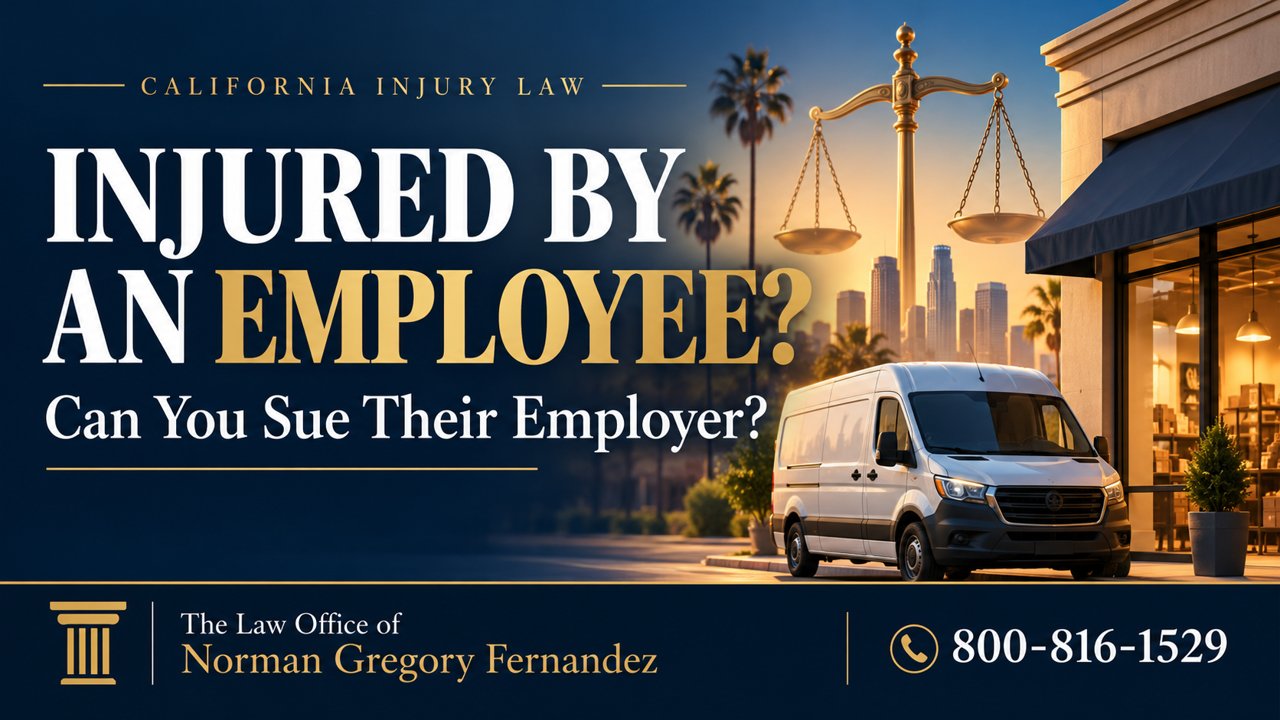
In this video, attorney Norman Gregory Fernandez starts with a delivery driver who runs a red light while making a delivery. The important question is whether the investigation should extend beyond the person who caused the crash.
When can an employer be liable for an employee’s negligence?
Vicarious liability concerns the relationship between the employee’s wrongful conduct and the work. The employer need not have personally caused the accident for this theory to apply. You still need evidence of the employee’s wrongful conduct, the relevant employment relationship, the connection to the work, and the resulting injury.
California Civil Code section 2338 addresses a principal’s responsibility for an agent’s negligence in the business of the agency. Judicial Council civil jury instructions CACI Nos. 3701 and 3720 explain employer responsibility and scope of employment. The focus is on what the employee was doing and how that conduct related to the business.
What does “scope of employment” mean?
CACI No. 3720 looks at whether the conduct was reasonably related to the employee’s assigned tasks or reasonably foreseeable in light of the business or job responsibilities. The analysis can be broader than whether a supervisor specifically approved the act. At the same time, a substantial departure for a purely personal purpose can change the analysis.
Consider a driver making a scheduled delivery, a maintenance worker handling equipment near customers, or a company truck driver transporting goods. Those situations warrant investigating the employer’s role. These are examples, not conclusions that every company involved must pay.
A company logo does not identify every responsible party
The name on a vehicle or storefront may differ from the legal name of the business that employed the worker. A delivery operation may involve a separate contractor, franchise, vehicle owner, or staffing company. Calling someone an “independent contractor” also does not, by itself, settle every question about the actual relationship or another party’s potential liability.
Preserve the names and identifying details you can safely obtain. An attorney can investigate the appropriate defendants and applicable insurance. For the delivery context, see our guide to California delivery-driver accident claims involving Amazon, UPS, and FedEx.
The employer’s own negligence is a separate question
Negligent hiring, supervision, or retention focuses on the employer’s conduct. Under CACI No. 426, important issues include whether an employee was unfit or incompetent for the work, whether the employer knew or should have known that this created a particular risk, and whether the employer’s negligence was a substantial factor in causing harm.
Training practices may also deserve investigation when supported by the facts. An accident alone does not establish inadequate training or negligent hiring. Prior warnings, relevant complaints, job qualifications, safety procedures, and the connection between an identified failure and the injury can matter. These records often require a formal request or discovery; an injured person should not try to access confidential company systems.
Evidence to preserve after an employee injures you
Put safety and appropriate medical care first. If circumstances permit, take these practical steps:
- Record the date, time, location, worker’s name, company markings, vehicle plates, and any incident or police report number.
- Photograph the scene and visible conditions from a safe location. Keep original files rather than only edited copies or social-media uploads.
- Save witness contact information, receipts, delivery messages, photographs, dashcam footage, and communications with the business or insurers.
- Identify nearby cameras promptly. Ask an attorney about preservation requests because recordings and electronic records may be overwritten.
- Keep medical records, bills, missed-work documentation, and an accurate account of symptoms and daily limitations.
Work schedules, dispatch records, route information, job instructions, and records identifying the employer may help establish why the worker was there. Their relevance and availability depend on the incident. If force by security personnel was involved, our article on injuries caused by store security guards and evidence of responsibility addresses that setting.
Frequently asked questions
Can I bring a claim against both the employee and the employer?
Potentially. The employee’s own conduct and the employer’s legal responsibility may both require review. Naming the right parties requires investigating the facts; the existence of two defendants does not mean you can recover twice for the same loss.
What if the employee was driving a personal car?
A personal vehicle does not automatically eliminate the work connection. Investigate the purpose of the trip, the employee’s tasks, and the applicable policies. Ordinary commuting and personal errands raise different issues and may involve exceptions requiring individual legal analysis.
Is this the same as suing my own employer for a work injury?
No. This article primarily concerns a person injured by someone else’s employee. If you were injured at your own job or by a coworker, workers’ compensation rules and possible third-party claims require separate analysis.
Should I wait for the company to finish investigating?
Do not assume an internal investigation protects your evidence or filing deadlines. Preserve your records and seek legal advice promptly. The applicable deadline can vary, particularly when a public entity is involved.
Talk with a California personal injury attorney
The Law Office of Norman Gregory Fernandez represents injured people throughout California. Norman Gregory Fernandez has practiced law since 1997, bringing nearly three decades of experience to case evaluation and representation. Not a settlement mill.
For a free consultation, call 800-816-1529. Be ready to explain what happened, who was involved, and what records you have. Our California personal injury case information center explains the claim process and how clients can help preserve useful information.
Attorney advertising. This article and video provide general information, not legal advice. Every case depends on its facts, applicable law, and available evidence. Viewing this page or contacting the firm does not by itself create an attorney-client relationship. No outcome is guaranteed. The video uses an AI-generated avatar presentation.
 About Attorney Norman Gregory Fernandez