
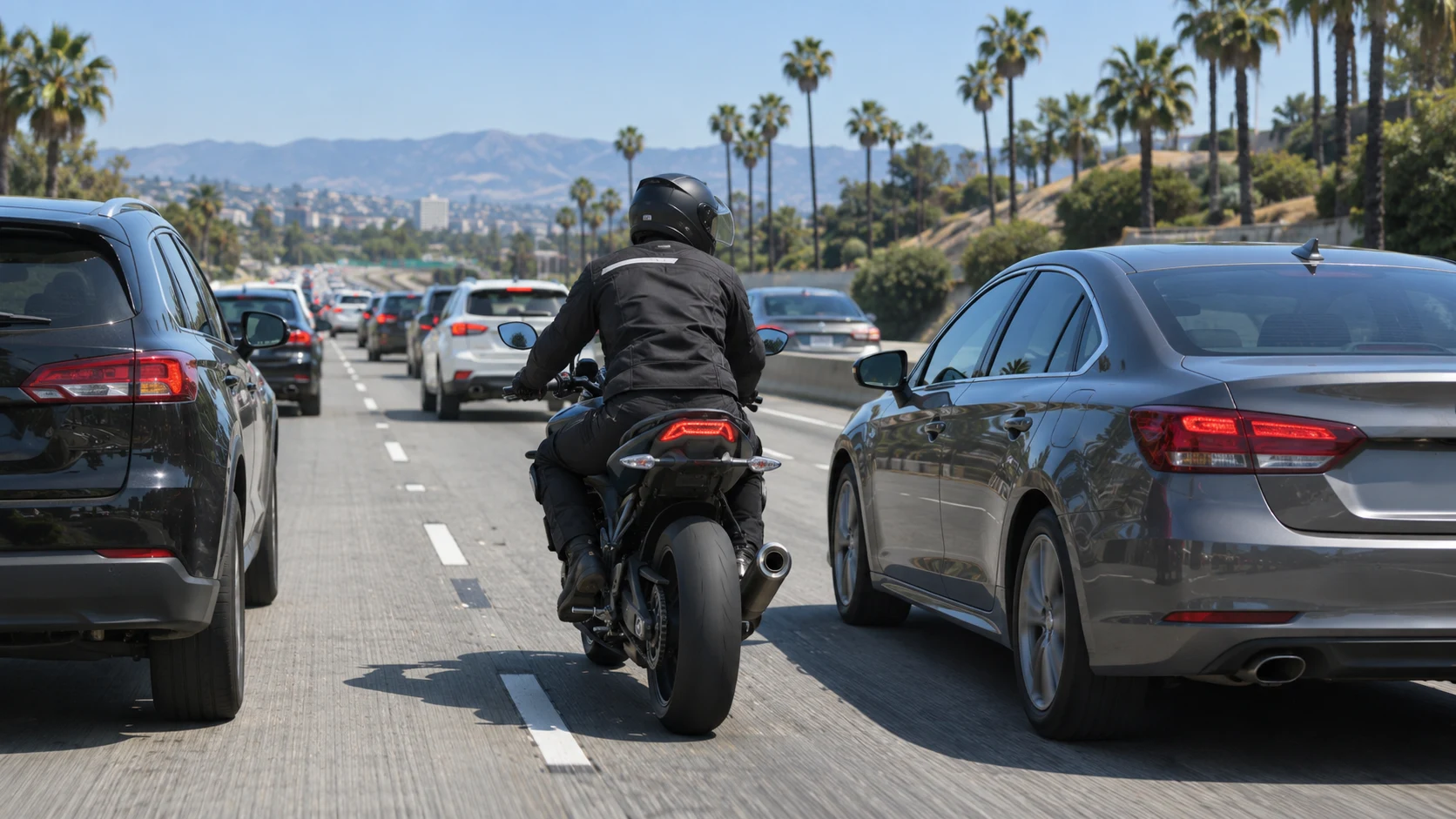
The driver says you came out of nowhere. You remember the car moving across the lane line just as you reached its rear door. After a California motorcycle lane-splitting crash, those accounts can sound impossible to reconcile. A few seconds of footage from a car behind you may show what neither person could see clearly from their own position.
California permits motorcycle lane splitting. Fault in a collision depends on how both people were driving or riding and what the evidence shows about the moments before impact.
What California law says about lane splitting
California Vehicle Code section 21658.1 defines lane splitting as riding a two-wheeled motorcycle between rows of stopped or moving vehicles. The California Highway Patrol explains that the danger increases with speed and with the speed difference between the motorcycle and surrounding traffic. In a claim, those details matter alongside the driver’s movement, available sight lines, and the time each person had to react.
Reconstruct the lane change before debating fault
Picture two lanes of traffic crawling past an exit. A sedan moves toward a gap in the next lane. A rider approaching between the rows strikes the sedan near its front door. The damage helps locate the contact, but the key question is what happened before it.
- When did the sedan move? A camera may show when the first tire crossed the line, whether the turn signal was visible, and how much time passed before impact.
- Where was the rider when the move started? Footage from behind may show how quickly the motorcycle closed the gap. A clip that begins at impact can miss that entirely.
- What could each person see? A tall vehicle, a curve, or a change in lane width can affect visibility and reaction time.
- What happened after contact? Resting positions may reflect braking, a fall, or vehicles moving out of traffic. Compare those positions with footage and damage before drawing conclusions.
California applies comparative fault. If a rider’s own negligence contributed to the injury, damages can be reduced by the percentage of fault assigned to the rider. For example, if damages are assessed at $100,000 and the rider is assigned 20 percent of the fault, the reduction would be $20,000. The percentage depends on the evidence in the individual case. See Judicial Council of California Civil Jury Instruction No. 405.
Which evidence is easiest to lose?
Dashcams often record on a loop. A witness may remember seeing the turn signal but forget exactly when it came on. A motorcycle may be repaired or transferred before someone documents the damage. Once you are safe and have arranged medical care, preserve what you can without returning to traffic or putting yourself at risk.
- Ask for the original clip. If a witness has footage, ask for the original file with the seconds before and after the crash. Keep an untouched copy. A social media upload may be cropped or compressed.
- Save witness names and contact details. Note where each witness was. Someone behind the sedan may have seen its signal while someone in the adjacent lane saw the motorcycle’s approach.
- Photograph the motorcycle and gear before repairs or disposal. Capture both sides and take wider photos that show where each close-up belongs. Keep existing tow and repair records.
- Write down the location while it is fresh. Include the direction of travel, nearest exit or intersection, approximate time, lane positions, and whether traffic was stopped or moving. Flag details you are unsure about so they can be checked later.
What if the police report says you were lane splitting?
Get a copy of the report and look at what it records. A responding officer may be relying on statements and where the vehicles ended up. Write down any factual discrepancies and save the evidence that could clarify them. If footage shows that a car was still in its lane a moment before impact, for example, that timing may help explain why a rider had little room to respond.
Get Help Now
The Law Office of Norman Gregory Fernandez represents injured riders across California. Norman is a lifelong rider and has nearly three decades of legal experience. Not a settlement mill. If a driver or insurer is blaming you for a lane-splitting crash, we can review the facts with you and explain your options. Call 800-816-1529 for a free consultation.
Attorney advertising. This article provides general legal information. Reading it does not create an attorney-client relationship.
 About Attorney Norman Gregory Fernandez