

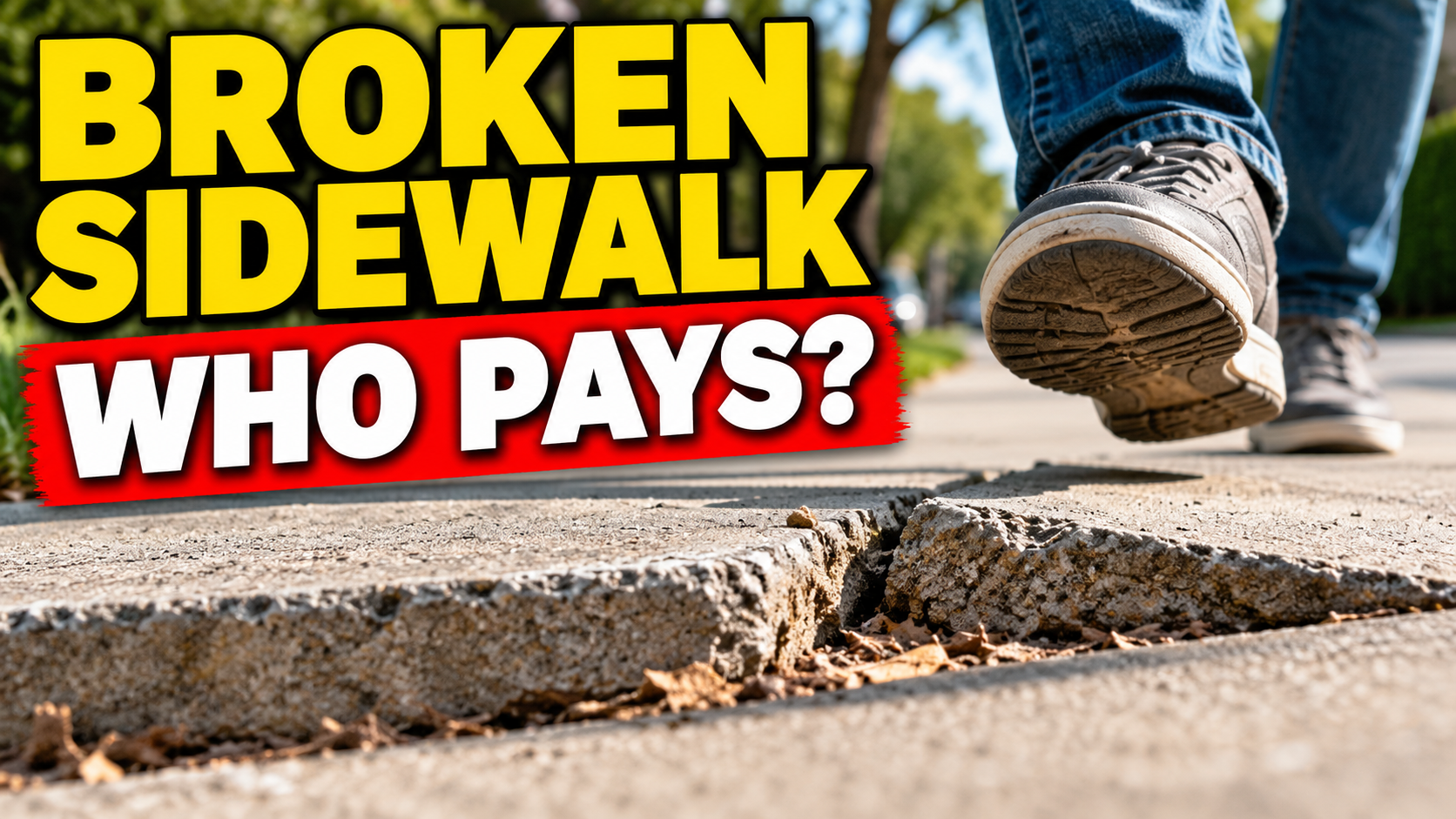
Tripped on a Broken Sidewalk in California? Who Is Responsible?
By Attorney Norman Gregory Fernandez | California Personal Injury Lawyer
You’re walking down a sidewalk, minding your own business, when suddenly your foot catches on a raised section of concrete, a broken sidewalk slab, or an uneven walking surface.
Before you know it, you’re on the ground.
You may suffer a broken wrist, fractured hip, knee injury, shoulder injury, head trauma, or another serious injury.
Now you’re facing medical bills, lost wages, pain, and uncertainty about your future.
Who is responsible for your injuries? The city? The adjacent property owner? Someone else?
The answer depends on the circumstances, and California law provides important protections for people injured by dangerous sidewalk conditions.
Watch My Video: You Tripped on a Broken Sidewalk. Who Is Responsible?
In this short video, I explain who may be responsible for a broken sidewalk and why you may have only six months to take action when a government entity is involved.
Who Is Responsible for a Broken Sidewalk in California?
Responsibility for a sidewalk accident isn’t always straightforward.
Depending on the facts, potentially responsible parties may include:
-
A city or other government entity responsible for public property.
-
An adjacent property owner whose conduct or legal obligations create liability.
-
A business or property manager responsible for a particular walking area.
-
A contractor or utility company whose work created a dangerous condition.
Simply because a sidewalk is located next to a business or private residence does not automatically mean the property owner is responsible.
Likewise, a city is not automatically liable for every sidewalk accident.
The key questions include who owned or controlled the property, what caused the dangerous condition, whether the responsible party had legally sufficient notice, and whether the condition caused the injury.
California Government Code Section 835: Dangerous Conditions of Public Property
California Government Code section 835 establishes the framework for holding a public entity liable for injuries caused by dangerous conditions of public property.
Generally, the injured person must establish that:
-
The public property was in a dangerous condition at the time of the injury.
-
The dangerous condition proximately caused the injury.
-
The condition created a reasonably foreseeable risk of the kind of injury that occurred.
-
The dangerous condition was created by a public employee’s negligent or wrongful act or omission within the scope of employment, or the public entity had actual or constructive notice of the condition sufficiently before the injury to have taken protective measures.
For example, a significantly raised sidewalk slab that has existed for an extended period may present a dangerous condition, depending on its height, visibility, location, and surrounding circumstances.
However, not every sidewalk irregularity is legally actionable. California law also recognizes defenses involving trivial defects, and each case must be evaluated individually.
Can a Private Property Owner Be Responsible for a Public Sidewalk?
Sometimes.
Although sidewalks are frequently public property, an adjacent private property owner may be responsible under particular circumstances.
For example, liability may arise when a property owner or another private party creates a dangerous condition, exercises relevant control over an area, or has a specific legal duty that supports liability.
California Streets and Highways Code section 5610 addresses certain sidewalk maintenance obligations of adjacent property owners. However, that statute alone does not automatically make an adjacent owner liable to an injured pedestrian.
Determining the responsible parties requires examining the property, the cause of the defect, applicable local ordinances, and the surrounding facts.
WARNING: You May Have Only Six Months to Present a Government Claim
This is one of the most important things to understand about sidewalk injury cases in California.
Under California Government Code section 911.2, a personal injury claim against a public entity generally must be presented within six months after the claim accrues.
That is substantially shorter than the ordinary two-year statute of limitations applicable to many California personal injury lawsuits.
And here’s another important distinction:
Presenting a government claim is not the same thing as filing a lawsuit.
California’s Government Claims Act establishes specific procedures for presenting claims against public entities. Additional deadlines apply depending on whether the claim is accepted, rejected, or otherwise acted upon.
Exceptions and procedures for seeking permission to present a late claim may apply in certain circumstances, but you should never assume an extension is available.
Waiting too long can jeopardize your right to pursue compensation.
What Evidence Is Important in a Broken Sidewalk Case?
If you’re injured because of a dangerous sidewalk condition, preserving evidence can be extremely important.
1. Photographs of the Dangerous Condition
Take photographs of the exact location where you fell, including the raised concrete, broken slab, uneven surface, or other hazard.
Capture both close-up photographs and wider views showing the surrounding area.
2. Measurements of the Sidewalk Defect
The height difference between sidewalk slabs or the dimensions of a defect may become important evidence.
If it can be done safely, document the condition with a ruler or measuring tape.
3. Witness Information
Obtain the names and contact information of anyone who witnessed the accident or knew about the dangerous condition before your fall.
4. Medical Records
Seek appropriate medical attention and accurately explain how the accident occurred.
Your medical records can help document your injuries, treatment, and recovery.
5. Prior Complaints and Maintenance Records
Depending on the circumstances, prior complaints, inspection records, repair requests, and maintenance documents may help establish whether the responsible party knew or should have known about the dangerous condition.
6. Surveillance Video
Nearby businesses, residences, or public cameras may have recorded the accident.
Because video recordings may be overwritten, identifying and preserving potential footage promptly can be important.
What Compensation May Be Available After a Sidewalk Accident?
If liability and causation are established, an injured person may be entitled to recover damages, depending on the circumstances.
Potential damages may include:
-
Past and future medical expenses.
-
Lost wages and loss of earning capacity.
-
Physical pain and suffering.
-
Emotional distress associated with the injury.
-
Other legally recoverable economic and noneconomic losses.
The amount recoverable depends on the evidence, the extent of the injuries, applicable legal limitations, and any comparative fault.
California follows a comparative negligence system, meaning an injured person’s own negligence may reduce the damages recoverable without necessarily eliminating the claim.
Don’t Assume Nobody Is Responsible Just Because You Fell on a Public Sidewalk
After nearly 30 years practicing California personal injury law, I know that determining liability often requires more than simply looking at where an accident happened.
A sidewalk may appear to be ordinary public property, but the legal responsibility for a dangerous condition can involve government entities, private property owners, contractors, or other parties.
The critical questions are:
What caused the fall? Who was legally responsible? What evidence establishes negligence? And what deadlines apply?
If you’ve been seriously injured because of a broken or dangerous sidewalk, don’t assume you have no case.
And don’t wait until the government claim deadline has passed before investigating your legal rights.
Free Consultation With a California Sidewalk Accident Lawyer
I’m attorney Norman Gregory Fernandez, founder of The Law Office of Norman Gregory Fernandez & Associates.
I’ve represented injured people throughout California for nearly 30 years in personal injury matters, including slip-and-fall accidents, trip-and-fall injuries, dangerous property conditions, automobile accidents, and other negligence cases.
If you or someone you love has suffered a serious injury because of a broken sidewalk, raised concrete, or another dangerous walking surface, my office offers a FREE consultation.
Visit: https://thepersonalinjury.com
We represent personal injury clients throughout California.
Don’t assume you have no case. Find out what your rights may be before an important deadline passes.
Legal Disclaimer: This article and accompanying video are provided for general informational purposes only and do not constitute legal advice. Reading this article, watching the video, or contacting the law firm does not by itself create an attorney-client relationship. Every personal injury case depends on its specific facts, evidence, and applicable law.
Related California Personal Injury Articles
- California Trip and Fall Accidents: Your Legal Rights – Learn how dangerous sidewalks, uneven pavement, and other walking hazards can lead to personal injury claims.
- California Premises Liability: Who Is Responsible for Unsafe Property? – Understand when property owners and other responsible parties may be liable for dangerous conditions.
- California Personal Injury Laws: Deadlines and Government Claims – Learn about California's personal injury deadlines, including the generally applicable six-month government claim requirement.
 About Attorney Norman Gregory Fernandez